


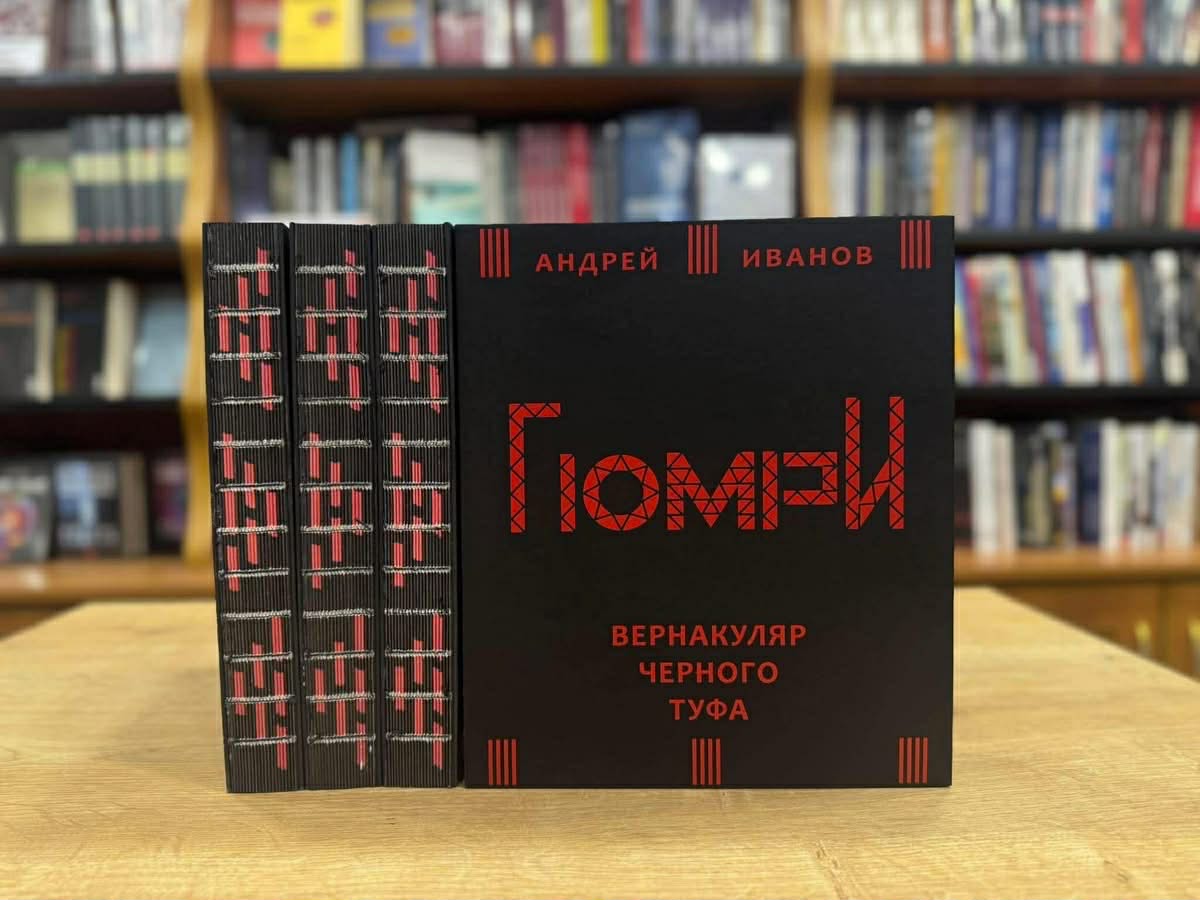
The second edition of “GYUMRI. The Vernacular of Black Tuff” has been released — a project that goes far beyond a photo album or an architectural study. It is a complex, multi-layered object in which the city is interpreted as a system of signs, and material as a language.
The author of the photographs is Andrey Ivanov. But in reality, what we see is more than a photographer’s взгляд: it is an attempt to capture Gyumri’s cultural code through its very substance — black tuff.
⸻
Concept: Vernacular as the Code of the City
The term vernacular in architecture usually refers to the “folk” or organically formed language of an environment. In the case of Gyumri, it is not a stylistic category, but the ontology of the city itself.
Black tuff here is:
- not just a building material
- not just a dominant color
- but a carrier of memory, rhythm, and the structure of urban life
This is why the book reads as a form of research:
Gyumri = material → form → behavior → memory
The photographs capture not façades, but underlying logics:
- repetition of ornaments
- rhythms of windows and openings
- wear and patina as a form of time
⸻
Visual Language: The Book as an Object
Special attention should be given to the book’s physical design.
The cover and spine, created by Karen Balyan, are not decorative elements but part of the concept:
- the geometry echoes tuff masonry
- the red-and-black palette reproduces the material and its tension
- the typography functions like architectural relief
Together with Grisha Karelski, a rare printing solution for Armenia was achieved:
- tactile quality of the cover
- depth of black
- structural spine design
Published by Antares, the book effectively becomes a physical continuation of the theme of tuff.
⸻
The Book’s Content Architecture
The project is constructed as a multi-layered archive:
1. Authorial Photography
Andrey Ivanov documents contemporary Gyumri — without romanticization, but with precision of observation.
2. Personal Perspective
Pages X–XI feature the section “The City of My Memories” (photographer Hayk Adamyan), introducing a subjective dimension — memory as a filter of the city.
3. Historical Layer
Photographs and postcards from the collection of Hayk Demoyan (pp. 25, 28, 56, 57, 79, 81, 145, 146) create a retrospective contour, allowing the viewer to trace the evolution of the environment.
4. Cinema as an Urban Archive
Frames from the films:
- “The Spring of Egnar”
- “The Slap”
- “Triangle”
- “Tango of Our Childhood”
add another layer — Gyumri as a cultural narrative.
5. Art in Space
The fresco by Minas Avetisyan (Grand Hotel Gyumri) is an example of how an artistic gesture integrates into the urban fabric.
⸻
Why It Matters
This book accomplishes a rare task:
it translates the city from the category of a “place” into the category of a “language.”
In terms of a research framework (cultural codes → behavior → development), the project can be interpreted as:
- documenting a cultural code (tuff, ornament, density)
- through visual patterns
- with the potential to influence perception and identity
Such artifacts become instruments of:
- cultural policy
- identity formation
- long-term transformation of behavioral models
⸻
Conclusion
The second edition of “GYUMRI. The Vernacular of Black Tuff” is:
- not just a book
- not just an album
- but a materialized theory of the city
A project in which:
- photography becomes research
- design becomes argument
- printing becomes meaning
⸻
📍 The book is available online or at the “DARAN” bookstore
(Yerevan, 16a Isahakyan Street)